

Commentary|Articles|July 31, 2026
Optimization or cherry-picking? The AI threat to accountable care
Author(s)Robert Resnik, M.D., MBA
Fact checked by: Richard Payerchin, Kirsty Mackay
Listen
0:00 / 0:00
Physicians drive savings, but AI could reward the intermediaries controlling ACOs.
Advertisement
Artificial intelligence (AI) is increasingly promoted as the breakthrough that will allow the Medicare Shared Savings Program (MSSP) and other Medicare risk-based models to finally achieve their full potential. Used well, AI can help primary care teams identify patients at increased risk, intervene earlier and reduce avoidable utilization.
But under today’s incentive structure, AI is just as likely to accelerate the program’s most problematic tendencies — particularly the growing role of cherry-picking high-performing practices, extracting a disproportionate share of savings and avoiding the harder work of improving struggling ones. Without policy correction, AI will not fix these models. It will potentially distort them further.
Who actually generates savings
The true engine of savings in accountable care is frontline clinical decision-making. Primary care physicians determine whether a condition is managed in the office or escalates to the emergency room, whether a referral is necessary and how consistently chronic disease is managed over time. These daily decisions are what ultimately bend the cost curve.
Yet the control of contracts, data and shared savings distribution is often concentrated in the hands of intermediaries: accountable care organization (ACO) operators, management services organizations and other enablement firms. These entities provide analytics, reporting and care management infrastructure, all of which can support performance. However, they do not generate the underlying behavior change or patient trust that drives cost reduction.
Despite playing this supporting role, many of these organizations capture a disproportionate share of the savings. In Centers for Medicare & Medicaid Services (CMS) programs, patients are effectively “free-range,” yet enablers frequently position their services as major drivers of cost reduction. These claims are often overstated. The most meaningful impact on both cost and outcomes continues to stem from the direct interaction between primary care providers and their patients. Clinicians — whose decisions prevent unnecessary use — often have the least influence over how savings are allocated, while entities furthest from the point of care retain the greatest control over financial flows, reflecting a structural paradox within these programs.
My view from the front line
In my work developing multiple ACOs and supporting participation across a range of CMS and Center for Medicare and Medicaid Innovation (CMMI) programs, I have focused on two core objectives: equipping frontline clinicians with actionable, practice-level data, and delivering hands-on, tailored support to clinics. Too often, ACO sponsors rely on standardized, one-size-fits-all approaches that prioritize checking compliance boxes over driving meaningful change, creating the appearance of cost curve improvement.
As part of a 12-clinic network of local independent primary care practices that I helped lead, we consistently ranked among the top performers in the CMMI Direct Contracting model on shared savings percentage. By any reasonable measure, we were already delivering the outcomes CMS is trying to incentivize.
When that model ended, and we sought a new partner, the proposals we received revealed a different reality. Rather than expanding success or supporting broader transformation, almost every enablement company proposed strategies centered on financial engineering and optimization: splitting clinics across multiple ACOs, excluding certain practices or placing clinics into different tracks solely to maximize returns.
These proposals were drenched in the usual value‑based care rhetoric, but for already high‑performing practices such as ours, they were unlikely to materially change how care is delivered at the bedside.
From a Medicare policy perspective, nothing about that strategy improves the program. It doesn’t bring new practices into accountable care, doesn’t support struggling groups, and doesn’t meaningfully deepen care transformation. It simply splits efficient clinics into multiple revenue streams to help maximize the enabler’s share of the savings and minimize risk.
This is where AI comes in. While it can strengthen primary-care-driven patient management, it can also accelerate this kind of financial gaming.
AI’s clinical promise — and strategic risk
AI has real potential to improve care. It can integrate claims, electronic health record, pharmacy and social data to identify patients at risk of hospitalization, detect patterns of overuse and guide more efficient referral and site-of-care decisions. Used appropriately, it can help physicians manage populations more proactively and effectively.
But those same capabilities can be used for a different purpose. AI allows intermediaries to analyze practice-level performance with unprecedented precision. They can model spending patterns, identify providers already generating savings and flag practices with more complex patients, weaker coding, or less favorable benchmarks. What was once intuition can now be executed with algorithmic accuracy.
When optimizing becomes cherry-picking
This is where the problem becomes structural. When AI is used to preselect only those practices most likely to generate savings, accountable care stops being about managing risk and starts becoming an exercise in risk avoidance.
Under current program rules, the incentives are clear:
- Recruit practices that already perform well and require minimal investment.
- Avoid those that need infrastructure, time and support.
- Place high performers into whichever models and tracks maximize financial return.
From a business perspective, this is rational. From a policy perspective, it undermines the program’s purpose.
Consequences for independent practice
These dynamics disproportionately harm independent primary care practices because CMS programs are structured in ways that often require intermediary participation. These entities gain leverage over these physicians because they lack the scale or capital to take risk or create a supporting infrastructure. AI could be used less to build physician capability and more to optimize portfolios.
Practices that would benefit most from support increasingly find themselves labeled as too complex or too risky. CMS headlines continue to tout strong participation and apparent program success, but a closer look shows growing consolidation among the entities that own ACOs and/or organizations that have become adept at minimizing their own risk while maximizing their upside on shared savings. The result is a significant part of the system that, despite appearing successful, may deliver only marginal improvement over its year‑to‑year baseline.
Three emerging risks
If left unaddressed, the combination of AI and misaligned incentives creates three clear risks:
- Value extraction over value creation: AI enables intermediaries to identify and capture existing savings without materially improving care delivery.
- Fragmentation of high performers: Efficient practices are divided across multiple contracts and models to maximize financial yield.
- Avoidance of true risk: Practices with the greatest opportunity for improvement are systematically excluded.
In this sense, AI could “ruin” these programs not by causing them to fail all at once, but by slowly turning them into a more polished version of picking winners and repackaging them. Over time, frontline physicians will become increasingly skeptical of these models, and intermediaries will grow more adept at exploiting the rules for their own financial gain
Realigning the incentives
The solution is not to reject AI or eliminate intermediaries. Many practices, especially smaller ones, benefit from external infrastructure and expertise.
But incentives must be reset.
CMS can take several steps:
- Increase support and favorable policies for physician-led and smaller ACOs.
- Require greater transparency in the distribution of shared savings.
- Reward organizations that successfully bring in and improve lower-performing or underserved practices.
- Strengthen oversight of aggressive, AI-driven selection strategies that undermine program intent.
AI will play a central role in the future of MSSP and other CMS models. Whether it strengthens primary care or accelerates financial extraction will depend less on the technology itself than on the rules governing its use.
Robert Resnik, M.D., MBA, is a board-certified internal medicine physician practicing in Cary, North Carolina. He earned his medical degree from Eastern Virginia Medical School and completed his residency at East Carolina University. He also holds a Master of Business Administration degree from Duke University.
Advertisement
Related to this article

RFK Jr. appoints members to fill a panel that has not met in more than a year, but is influential on primary care.
CMS chief says outcomes-based pay can help patients while finally ending physicians' box-checking frustration.

Reactions from five leading organizations were among thousands of public comments on the draft document.
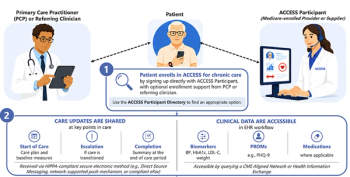
Physician groups back ACCESS Model but warn CMS against care fragmentation
Top HHS leaders introduce ACCESS model with discussions of patient health, costs and technology.

Independent primary care is struggling under a payment system stacked against it
Advertisement
Advertisement
Trending on Medical Economics
1
Dr. Oz on ACCESS: Let’s treat patients instead of just checking boxes
2
What they're saying about the draft 2027 Medicare Physician Fee Schedule
3
AI in rural primary care: 6 questions physicians must answer with their nurses and APPs
4
Hiring more specialists alone won't shorten wait times, NEJM Catalyst analysis argues
5