Reactions from five leading organizations were among thousands of public comments on the draft document.
CMS chief says outcomes-based pay can help patients while finally ending physicians' box-checking frustration.
Doctors have been trapped for years in health care that has become a frustrating exercise in checking boxes instead of alleviating chronic diseases in patients.
But that ends with a new payment model built around patient health outcomes, Medicare’s top leader said.
Instead of checking boxes, physicians will be guided by key questions about patient care, Oz said.
“What if instead of me having you check boxes, I said, ‘Did you find a problem that you treated, and did you impact that problem in a way that all of us would agree was beneficial?’” he said.
Oz, a heart surgeon before becoming CMS administrator, said rigid quality standards put physicians in an uncomfortable bind: prescribe a drug or order a test a patient doesn't need just to satisfy a metric, or skip it and lose credit for care. That mismatch breeds bad documentation and, sometimes, box-checking for its own sake, he said.
Blood pressure control is a simple example of what paying for outcomes could look like instead, Oz said. Measuring it is easy and cheap, but many patients never get it checked, and even when they do, tracking a number alone doesn't fix what is driving it up.
“It’s like a fire hydrant that’s busted, and the water’s skirting everywhere,” Oz said, describing high blood pressure. Persistently elevated pressure scrapes and scars the lining of the arteries, he said, eventually producing the plaques that can rupture and block blood flow. It’s a cascade of events that used to bring patients to him for heart surgery that might have been prevented with earlier intervention.
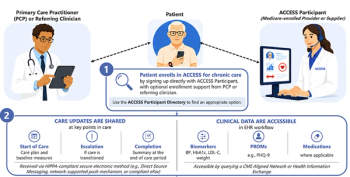
Oz said the ACCESS Model’s use of remote monitoring and connected devices is also meant to fix a communication problem that has little to do with technology. Patients frequently leave the office having absorbed only a fraction of what they were told, he said, and traditional care has few good ways to reach them again once they’re home and ready to act.
“The worst time I talk to a patient is often in your office,” Oz said. “50% of what patients hear in the office, we know they forget before they leave the room.”
Rather than deliver every instruction once, in person, Oz said the goal is to give patients information they can revisit and share with family, delivered at moments they’re actually receptive to it rather than whenever it’s convenient for the clinician. Patients who don’t want that kind of outreach can opt out, he said, adding that concerns about medical record privacy are legitimate and have to be addressed.
Doerr asked how CMS plans to responsibly bring artificial intelligence (AI) into a system where patients don’t want technology just for technology’s sake. Oz said he was setting aside the broader debate over AI’s risks to focus narrowly on what it can do for health: helping physicians do a better job caring for patients, helping nurses manage chronic illness, and improving navigation and transparency for patients.
“The most expensive health care is bad quality care,” Oz said. Paying someone unqualified to do work they shouldn’t be doing, then paying someone else to fix the resulting problem, and then paying again for the downstream complications, drives costs up in ways AI-assisted care could help prevent, he said.
Oz said he wants states to eventually apply the same outcomes-based approach to Medicaid, which he called the payer of last resort for a population, including children covered through the Children’s Health Insurance Program (CHIP) and low-income seniors who are dually eligible for Medicare and Medicaid, that has the least backup and the most need. He cited Hubert H. Humphrey, the senator and vice president who is namesake of HHS headquarters, describing government’s obligation to people at the beginning of life, the end of life and those who have fallen and need help getting back up.
Extending outcomes-based support to substance use disorder treatment, consistent with the White House’s Great American Recovery Initiative, is part of that effort, Oz said. He also pointed to the concentration of Medicare spending on the highest-cost patients as a reason to invest in prevention.
“We spend an inordinate amount of money on the sickest 1% of Americans,” Oz said, adding that reducing that concentration could free up money for preventive care instead.
Interoperability is improving in ways that make that kind of coordination easier, Oz said. About 5% of patients could effortlessly access their medical records digitally when the current administration began, he said. That figure is now around 60% and rising toward 80%. Part of that progress, he said, comes from an internal effort he called “killing the clipboard,” aimed at ending repetitive paperwork such as re-entering the same medical history at every new office visit, which he credited to the team led by Amy Gleason in the Office of Health Transformation and Products.
Oz closed by telling the technology and health care leaders in the room that the ACCESS Model’s launch is a rare opportunity that depends on getting the collaboration right the first time.
“You are a part of history in a way that I think years from now, when you look back on it, you realize that was a sentinel moment,” Oz said. “Let’s not screw it up. We don’t get two chances at this.
“If we get it right, it’s going to be a beautiful symphony,” he said. “If we get it wrong, a very loud and potentially dangerous cacophony.”