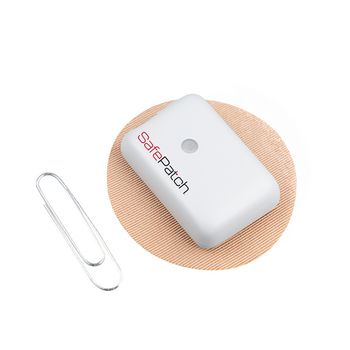
Cerna Healthcare's SafePatch is a wearable skin patch that detects falls, tracks activity and sends emergency alerts to family or professional monitors, with shipping set to begin in October.
The 510(k) clearance adds a porous 3D-printed titanium interbody with dual spike-and-screw fixation to the company's Saber cervical platform.
Elevation Spine announced that the U.S. Food and Drug Administration has granted 510(k) clearance for Saber-C AVIA, the newest addition to its Saber platform of zero-profile anterior cervical devices.
The system is designed as a zero-profile anterior cervical discectomy and fusion (ACDF) construct, combining the biomechanical stability typically associated with traditional plating with a porous 3D-printed titanium interbody. Saber-C AVIA offers both spike and screw fixation options, giving surgeons flexibility to choose the approach best suited to a given case.
"Our dedicated Saber-C surgeon community gave us valuable feedback, and those conversations shaped what came next," said Charlie Gilbride, CEO of Elevation Spine, in a statement. "We focused on purposeful instrumentation, a porous 3D titanium implant supported by preclinical research, and thoughtful refinements that build on the strengths of the original platform. Our size is one of our greatest advantages. We stay close to our surgeon network, move quickly on their feedback, and remain focused on delivering meaningful innovation where it matters most."
According to the company, the new system provides a slim, lower-profile workflow, with additions and refinements across multiple instruments. Most of the core Saber-C spike instruments have been updated for more precise spike delivery, and new Saber-C screw instruments have been added, including a very low-profile screw inserter. Saber-C AVIA ships with both spike and screw instrumentation in a single tray for every case, which the company said is intended to offer maximum
The porous 3D-printed titanium interbody features a 55% porosity lattice architecture engineered to mimic trabecular bone. Elevation Spine said the porous structure is associated with bone ingrowth in preclinical data, though the company noted this data is on file and has not been independently published. The implant is available in 6° lordotic and 12° hyperlordotic options with a large central graft window.
Saber-C AVIA is available immediately for surgical use in the United States, the company said.
The clearance adds to a steady stream of recent 510(k) clearances in the cervical and