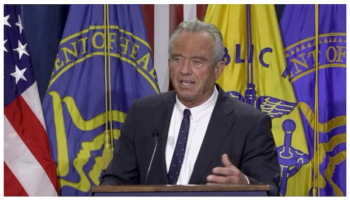
RFK Jr. appoints members to fill a panel that has not met in more than a year, but is influential on primary care.
The top news stories in medicine today.
Eleven co-conspirators were previously charged in connection with the same scheme.
Two Georgia men have been sentenced to prison for their roles in a scheme that submitted more than
Reyad Salahaldeen, 57, who controlled four laboratories across New Jersey, Georgia and Texas, was sentenced to 151 months in prison; Mohamad Mustafa, 28, received three years. Prosecutors said the two paid kickbacks to a network of marketers who collected DNA samples through telemarketing, health fairs and door-to-door solicitation, then obtained fraudulent test requisition forms from physicians who had no relationship with the patients and never used the results in treatment. Salahaldeen attempted to flee to Mexico after learning of his arrest warrant and was apprehended at the border while presenting someone else's identification. In addition to their prison terms, Salahaldeen was ordered to pay more than $84 million in restitution and Mustafa more than $64 million. Eleven co-conspirators, including three physicians and two nurse practitioners, were previously sentenced in connection with the scheme.
The Most Favored Nation framework ties U.S. drug prices to what other high-income countries pay.
The Trump administration said Tuesday its "Most Favored Nation" drug pricing framework is projected to generate $64.3 billion in federal and state savings over the next decade, with broader domestic savings across all markets estimated at $529 billion over the same period. Under the voluntary framework, manufacturers agree to offer new drugs launched in the U.S. at prices comparable to those paid in other high-income countries.
The administration said it has reached MFN pricing agreements with 17 pharmaceutical companies so far, covering Medicaid and cash-paying patients, and expects to extend similar agreements to most manufacturers of sole-source brand name drugs and biologics. The framework also secured price reductions for GLP-1 drugs and expanded Medicare coverage for obesity treatments.
Researchers say oral GLP-1 drugs reach deeper into the brain than previously thought, and may curb more than hunger.
The finding points to a mechanism separate from the appetite-suppressing pathways that injectable GLP-1s like semaglutide are known to engage. Once triggered, the central amygdala reduced dopamine release in the brain's reward circuitry during eating for pleasure rather than hunger. Researchers say the findings raise the question of whether oral GLP-1s might also reduce cravings for alcohol or other substances, and follow-up studies are planned.
“We’ve known that GLP-1 drugs suppress feeding behavior driven by energy demand. Now it seems oral small-molecule GLP-1s also dial back eating for pleasure by engaging a brain reward circuit,” said co-corresponding author Ali Guler, Ph.D., a professor of biology at the University of Virginia.