

Partnership of six associations aims to give private practices a voice in changing healthcare environment.

Partnership of six associations aims to give private practices a voice in changing healthcare environment.

Experts say rather than a simple rebranding of current programs, CMS is refocusing on the true purpose of EHR use by hospitals and physicians.

The Joint Commission’s “misconceptions” on pain just don’t make sense as many see it as the key to today’s opioid crisis.

Partnership seeks to better understand the factors affecting how physicians practice medicine

Input from our "Your Voice" letters to the editor. Here, a letter on the ACA.

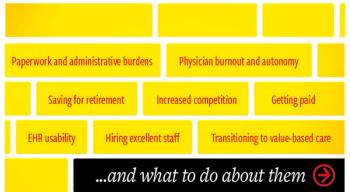
To say it is not easy to be a physician today is a gross understatement.

How top officials in the Trump Administration are faring.

The USDA’s plans to ship pre-filled food boxes to Americans is well-intentioned, but has its flaws as well.

Healthcare is not returning to paper, so rather than complain about the digital obstacles in their way, physicians should put that energy into meaningful change.

It's ironic: Experts in health IT concur that a major reason for healthcare systems shifted from paper to digital records was to reduce medical errors, but at the same time research has shown that EHRs actually introduce new kinds of errors.

For drugs or medical devices to be approved, there must be evidence that benefit significantly outweighs risk. This is to protect the public. A glaring exception is today's EHRs, which were mandated by the 2009 HITECH Act.

One doc's perspective on how the White House has done when it comes to fixing healthcare.

Industry insiders share their views of how healthcare is moving steadily toward a connected future.

Time spent on EHR data entry instead of interacting with patients is a common complaint from doctors.

ChangeMaker Ira Rubin, MD, and his son, Zachary, discuss the value of reaching out to young people interested in medicine to make today’s students tomorrow’s physicians.

In this podcast, Dr. Forrest highlights the failures he has experienced over the years since starting a DPC practice, and explains how other physicians can learn from his mistakes.

Because of his vast knowledge of the novel practice model, we asked Brian Forrest, MD to give us his best advice for physicians who are wanting to start their own DPC practice and be successful

CMS announces a commitment to give patients control of their records.

Perils of Replacing Physicians with Non-Physician Providers, Part 2

Pamela Wible, MD, has dedicated herself to raising awareness about this issue and changing the conditions that lead so many physicians to take their own lives. Here's what Wible says physicians can do about the suicide issue to help themselves and others.

Tired of preparing for a Maintenance of Certification (MOC) test that didn’t reflect his skills or what he practiced on a daily basis, Paul Teirstein, MD, set out to create an alternative to the process.

Medical Economics spoke with Forrest on his motivations for starting a DPC practice and where he sees the movement heading.

Medical Economics recently spoke with Peter Goldbach, MD, chief medical officer with Health Dialog, a provider of population health management services, on the importance of shared decision-making in medical care and improving patient outcomes.

Value-based care has maintained broad support, even in the highly partisan atmosphere in Washington

For 2018, there are changes to the requirements of CPC+. I will focus on the CPC+ electronic clinical quality measures (eCQMs).