
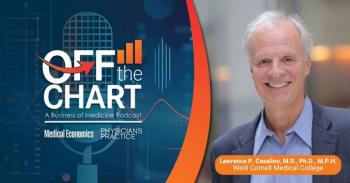
Lawrence Casalino, M.D., Ph.D., M.P.H., argues that as medicine consolidates, physicians are increasingly treated as interchangeable parts, and that the damage shows up in the parts of care no quality program measures.
Lawrence Casalino, M.D., Ph.D., M.P.H., argues that as medicine consolidates, physicians are increasingly treated as interchangeable parts, and that the damage shows up in the parts of care no quality program measures.

The top news stories in medicine today.

News & Analysis
AAFP issued its fall COVID-19, flu and RSV recommendations Wednesday, saying it coordinated with three other societies, while the coverage rules, counseling pay and registry logic behind them have not caught up.

From fake treatment ads to financial scams, deepfake technology is putting physicians' identities at risk

Physicians Foundation findings point to problem getting worse as doctors’ time constraints increase.
AI should reduce clerical work while increasing supervised reasoning, feedback and clinical judgment for developing physicians.


Interview
Medical Economics spoke with Michael Pelagalli, J.D., partner at internet defamation firm Minc Law, about where the legal line sits and what a practice should do first.

News & Analysis
A Hint Health whitepaper says direct primary care's longer visits make it the natural home for lifestyle medicine. Nearly half of practices surveyed have panels under 200.

Slideshow
What physicians need to know about the AMA's new AI framework

News & Analysis
The pharmaceutical distributor says attackers accessed oncology and surgical customer data; a hacking group claims 284 million patient records were stolen.
How contemplation can restore a sense of purpose in doctors and other clinicians


Despite major problems across U.S. health care, evidence shows what primary care is getting right.

An HHS video sent patients to a Medicare comment docket that has already drawn more than 19,000 submissions.

Retirement is about transitioning to something, not escaping from something else

The $12.8 million all-cash deal adds a North Carolina-based biomedical calibration provider to Transcat's regulated life sciences portfolio.
For years, falling claims frequency quietly held malpractice premiums down, and there are early signs that's about to stop.


Peterson Health Technology Institute's Caroline Pearson explains why payment models — not the technology itself — will decide whether AI lowers costs for physicians and patients.

Expert Insights
Here are five strategies for independent practices to keep the doors open.

Concierge and direct primary care sites grew 83.1% in five years, and direct primary care starts 2026 with a federal tax break it did not have before.

A ransomware-style disruption at one of medicine's largest device manufacturers is the latest reminder that a hack three steps removed from your exam room can still cancel a procedure on your schedule.

A beneficiary, other than a spouse, can face a big tax bill when inheriting an annuity. Choosing annuitization or the "stretch" option lets you soften the blow by extending tax deferral.
Payment models should reflect not just the theoretical value of services rendered, but the practical realities of how healthcare is financed and paid for today.

Big groups clean up in independent dispute resolution, but little, if any, goes to primary care.

Cost trends keep outrunning forecasts in recent years. The Business Group on Health survey shows that next year will follow the same trend.
Fifteen years of research hasn't moved the federal rules that keep new physician-owned hospitals from opening.


The approval lets patients using the investigational Connexus BCI connect personal laptops, tablets and phones through the company's Convey system without device-by-device FDA sign-off.