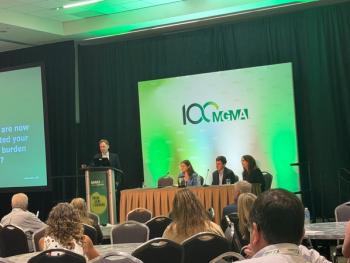
Medical Economics spoke with MGMA's Madison Hynes about the association's draft bill to ban automatic downcoding, the Patients First Act and AI-run prior authorization in traditional Medicare.
The top news stories in medicine this week.
The Senate health committee chairman says her role in the Aug. 10 childhood vaccine order is almost disqualifying on its own.
President Donald Trump
Overton earned her medical degree from the University of New Mexico and a doctorate in clinical investigation from Johns Hopkins University, and she was chief policy officer at the America First Policy Institute, a conservative think tank, before joining the administration. If confirmed, she would run an agency of
Two parts of her record are drawing scrutiny. Overton appeared with Trump at the Aug. 10 signing of an executive order calling for childhood vaccines to be spaced out and for the combined measles, mumps and rubella (MMR) shot to be split into three single-disease vaccines. At that event she said the administration still recommends the measles vaccine for all children but wants parents informed about timing and given the option to separate the doses.
She has also long opposed abortion. In papers written at the America First Policy Institute, she argued that mifepristone is dangerous to women and called on the federal government to ban its distribution by mail. As commissioner, Overton would oversee the rules governing it.
Bill Cassidy, M.D. (R-Louisiana), a physician who chairs the Senate Health, Education, Labor and Pensions (HELP) Committee,
The AMA found one plan posting an 832-page list of billing codes without a word of plain English.
CMS has updated its guidance on federal prior authorization transparency requirements, the
One plan posted an 832-page list of billing codes without a word of plain English, AMA President Willie Underwood III, M.D., M.Sc., M.P.H., said in a statement. Others buried required information behind physician or member portals and deep within plan websites, reported turnaround times without units, published statistics that did not add up, and omitted entire categories of care including behavioral health and post-acute services.
The AMA documented the problems and recommended corrective actions in a May 22 letter to CMS, followed by additional comments.
CMS incorporated several of those recommendations. Disclosures are not publicly accessible, the agency says, if they are available only through password-protected portals or cannot be reached through ordinary navigation from a payer's public-facing website. Plans must publicly identify all medical items and services requiring prior authorization.
Lists of procedure codes without plain-language descriptions do not satisfy the requirement, and CMS recommends a single comprehensive list organized by uniform service categories, with CPT codes, plain-language descriptions and a machine-readable format.
Every turnaround-time metric must include a unit of time, and median turnaround times of less than one day must be reported in hours rather than rounded to zero days.
The AMA is urging CMS to go further by defining prior authorization based on how the process functions regardless of whether a payer calls it precertification or advance notice or delegates it to a third-party utilization management vendor, by linking directly to plan prior authorization requirements from Medicare Plan Finder and HealthCare.gov, and by requiring rather than recommending standardized reporting templates.
Underwood called the guidance an important step but said "the work is not finished."
Related content:
Once AI alone beats physicians at a task, the authors argue, putting a physician back in to check the work makes results worse.
A
Among the studies cited: OpenAI's o3 model ranked the correct final diagnosis first in 60% of 377 real-world complex cases, while 20 internal medicine physicians did so in 15.9% of a 302-case subset. Microsoft AI Diagnostic Orchestrator, held to an $8,000 testing budget on 56 complex cases, reached the correct diagnosis 4.02 times more often than physicians working without access to colleagues, textbooks or the internet, at 19.1% lower cost per case. A 2024 meta-analysis of 106 human-AI experiments found that pairing a human with AI improved results when the human was already the better performer, but significantly worsened performance when AI alone was better.
Neal Khosla is CEO of Curai Health, an AI primary care company, and Vinod Khosla has invested in OpenAI, Curai Health and Limbic. Their position runs counter to the AMA and the
The authors list their own caveats. Most of the supporting evidence comes from simulations of discrete cognitive tasks rather than real clinical encounters. Liability, regulatory and reimbursement barriers limit study of AI alone in live settings. Adversarial stress testing shows large language models remain brittle in some cases. And many cognitive tasks are tied to physical procedures such as surgery, deliveries, interventional radiology and colonoscopies that robotics cannot yet perform autonomously.
Even so, the authors argue, superior autonomous AI will likely be ready to deploy in some, maybe many, workflows by 2030.