U.S. Preventive Services Task Force is poised to end 20-month hiatus with meeting starting today.
U.S. Preventive Services Task Force convenes to review evidence on primary care screenings, counseling and medications.
The U.S. Preventive Services Task Force (USPSTF) has begun “the start of a new era” examining medical evidence about the best ways primary care physicians can keep their patients healthy.
On Nov. 19, task force Chair Seth J. Corey, M.D., M.P.H., kept his remarks relatively brief when USPSTF opened its first meeting since March 2025, and what appeared to be the first meeting presented online. The first morning of the two-day meeting was devoted to clinical recommendations.
Corey called the period “very exciting” for the task force. He credited Health and Human Services Secretary Robert F. Kennedy Jr. and Agency for Healthcare Research and Quality (AHRQ) Director Roger D. Klein, M.D., J.D., for opening meetings to the public. The public will continue to have the opportunity to nominate members and topics through the task force website, he said.
“Our goal is really to meet, go over the evidence-based medicine with the goal of improving the lifespans and the quality of lives of all Americans,” Corey said.
The panel, whose recommendations determine which
USPSTF operates with support from AHRQ, and Klein was the first speaker when the meeting opened online. The meeting was the culmination of work that began after the U.S. Supreme Court’s 2025 ruling in Kennedy v. Braidwood Management, he said.
“I can’t tell you how happy and pleased I am to be here today,” Klein said.
Task force meetings historically have been closed and by invitation only, he said.
“As part of the Trump administration’s emphasis on transparency, we’ve decided to, for what I believe may be the first time, livestream these meetings, make them open to the public,” he said. Most of the meeting would be open, he said, “so that everybody can see exactly what’s going on, how the meetings take place, and how the members interact.” The USPSTF posts agendas and video recordings on its
The draft cardiovascular recommendation would be presented and deliberated in the open, “something that hasn’t been done before, but I think helps connect the task force to the external clinical world,” Klein said.
The
AHRQ has been working to build an analogous program alongside the federal one that would essentially duplicate the task force’s past ethics process, “and we’re a good ways there,” Klein said.
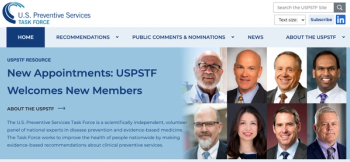
He thanked AHRQ staff for organizing a meeting that was challenging and “a lot to throw together (amid) a lot of commotion and tumult.” He welcomed both the legacy members and the new appointees, describing them as “some of the most accomplished people to join the task force.” He also praised Corey.
“He’s as thoughtful as he is smart, and I think he’s going to be a terrific chair,” Klein said.
Later in the day, members would discuss use of AI in health care and in the research processes that support it. In his preamble, Klein promoted AHRQ’s
“It isn’t here yet, but it is coming,” he said. Klein, a molecular pathologist, compared it to genetic sequencing, which once took weeks or months for a single gene and now can cover a whole genome in about a day for a few hundred dollars. “So that’s what’s going to happen with superintelligence applied to evidence,” he said.
Before the first topic, Corey read the members’ conflict-of-interest disclosures. For cervical cancer screening, Sei Lee, M.D., M.A.S., and Joel Tsevat, M.D., M.P.H., had level two disclosures, which are announced but do not limit participation. Venkatesh L. Murthy, M.D., Ph.D.; Ronald P. Karlsberg, M.D.; and Dennis W. Wulfeck, M.D., MBA, D.H.A., were recused from that topic.
The USPSTF typically meets three times a year, in March, July and November. Its July 2025 meeting was canceled two days before it was to start, according to a
Meanwhile, the panel’s leadership changed. Kennedy