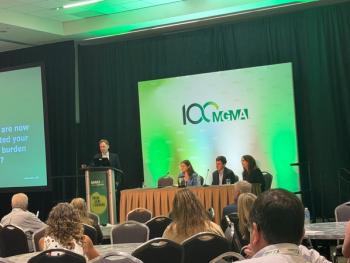
From a same-day payment cut to AI-run prior authorization in traditional Medicare, MGMA's government affairs team laid out what Washington has in store for physicians next year.
EBRI data show employer plans pay hospital outpatient departments about twice what physician offices receive for the same physician-administered drugs, and the commercial market has barely begun to address the gap.
Picture a community infusion practice the month after a hospital system acquires it. The same oncologist orders the same biologic, the same nurse hangs the bag and the patient sits in the same infusion room. The only thing that changes is the billing entity, which now submits the claim as a hospital outpatient department. For the employer footing most of that bill, the allowed amount for the identical dose can climb sharply.
That gap now has a fresh price tag. An
The authors, Paul Fronstin, Ph.D., EBRI's director of health benefits research, and M. Christopher Roebuck, Ph.D., president and CEO of RxEconomics, analyzed 2023–2024 commercial claims from the Merative MarketScan database, covering 10.9 million adults ages 18 to 64 with employment-based coverage. They focused on the 106 highest-spending PAODs, which account for 51% of all PAOD claims and 77% of PAOD spending under the medical benefit.
For physicians, the report matters less for what it says about employer spending than for what it suggests about where payment policy may go next. Medicare has started moving toward site-neutral payment. Commercial insurance, which is where these markups are measured, largely has not.
The EBRI analysis found that 59% of PAOD administrations took place in HOPDs, compared with 31% in physician offices and 9% in other settings, most often patients' homes.
Allowed amounts, meaning the combined payment from the plan and the patient, were higher in HOPDs for 93 of the 106 drugs studied. On a per-unit basis, HOPDs were paid an average of 102% more than physician offices for the same medication, and the median markup was 64%. The median annual difference in reimbursement came to $5,531 per patient, and for one oncology drug the difference reached $135,306 per patient.
Across the 106 drugs, the authors estimate $9.8 billion in potential annual savings, or about $77 per covered member. Extending the same markup to all PAODs raises the figure to roughly $12.7 billion, or about $101 per member, which is about 1% of total health spending for workers and their dependents.
The authors are careful about what that estimate represents. Their model holds utilization constant and asks what spending would have been if PO rates applied to the same units already given in HOPDs. It does not assume that every infusion can or should move out of the hospital.
On the public side, site-neutral payment has gained real momentum. In July 2025, CMS proposed
Drug administration was one of the first services to be addressed. Brown University health economist Christopher M. Whaley, Ph.D., told Medical Economics in February that
Whaley also pointed to the commercial spillover that the EBRI data now quantify: "This has been, I think, a pretty strong driver of both increased spending in the Medicare program, as well as among commercial insurers, and it's also been a strong driver of why the health care system in the United States is so consolidated."
EBRI's authors make a similar point in their conclusion. Policymakers have mostly debated site-neutral payment in the context of public programs, they write, but the differences may be even larger in commercial markets, where comparable approaches remain far less common.
Hospitals have pushed back on both fronts. In a July 2025 statement reported by Medical Economics, Ashley Thompson, senior vice president of public policy analysis and development at the American Hospital Association, argued: "Studies show hospital outpatient departments are more likely to serve Medicare patients who are sicker, more clinically complex, and more likely to be disabled or living in poorer, rural communities than patients treated in independent physician offices."
For independent physicians, the markup is not an abstraction. It helps explain who can afford to buy practices and why.
The EBRI brief lists several reasons care has shifted toward HOPDs. Hospital systems often have more negotiating leverage with commercial insurers than independent practices do. HOPD claims can carry facility payments that physician offices cannot bill. And for drug-intensive specialties, the federal 340B Drug Pricing Program lets eligible hospitals buy certain outpatient drugs at a discount while being reimbursed at negotiated commercial rates. The brief also notes that when a hospital acquires a practice, services may be reclassified as hospital outpatient services even when patients receive care in the same physical location.
Internist Robert Resnik, M.D., MBA, wrote in Medical Economics in September that
Resnik called site-neutral payment the essential structural reform: "As long as the same service pays substantially more when billed through a hospital-owned site than an independent physician office, hospitals and other acquirers will continue to outbid independent primary care and specialty practices."
Commercial reform proposals are beginning to aim at that incentive directly. A September 2026 Georgetown University policy brief, covered by Medical Economics, recommends
One of the EBRI report's most practical findings for physicians concerns who would actually benefit if the gap closed.
Among claims for the 106 drugs, 90% had no deductible payment, 80% had no coinsurance and 97% had no copayment. Deductibles made up only 1.1% of total spending and coinsurance 1.7%. Patients receiving these therapies tend to be heavy users of health care who often meet their deductibles and out-of-pocket maximums early in the plan year. Once that happens, they have little financial reason to care which site bills for their infusion.
As a result, the authors find that most immediate savings would go to employers and insurers rather than to patients at the point of service. Workers would benefit indirectly over time through slower growth in plan costs and premiums.
The implication for practices is that patients are unlikely to move care on their own. Any shift will come from purchasers. The EBRI authors point to contracting strategies, site-of-care programs, network design and reimbursement policy as tools employers and insurers can use. For independent practices with infusion capacity, that could create an opening as employers look for lower-cost sites that can safely administer specialty drugs.
The authors also note a limit on that approach. Hospital acquisitions of physician practices can reduce purchasers' negotiating leverage, which makes market-based solutions harder to carry out in some regions. In markets where few independent infusion sites remain, there may be little lower-cost capacity for employers to steer patients toward.
The trend data contain some encouraging news for independent practices, along with a caveat. Using the 70 drugs from EBRI's 2021 analysis that could still be tracked consistently, the median HOPD markup fell from 98% in 2019 to 70% in 2024.
That narrowing did not come mainly from hospitals being paid less. It came from physician offices being paid more. Among the 20 drugs with the highest HOPD spending in 2024, PO reimbursement rose about 17% between 2019 and 2024.
That runs against a broader pattern documented elsewhere. The brief cites a 2023 Blue Health Intelligence analysis that found reimbursement for common outpatient procedures rose 27% in HOPDs between 2017 and 2022, compared with 2% in physician offices. Physician-administered drugs appear to be one area where office-based reimbursement has gained some ground. Even so, a 70% median markup leaves a large gap.
The EBRI findings add to a body of evidence that has been building for years. EBRI's earlier studies of oncology drugs, lab tests, imaging, biologics and biosimilars all found that HOPDs were paid substantially more than physician offices for clinically comparable care. The authors describe the pattern as consistent across service categories and argue that it reflects the structure of commercial payment rather than differences in the care delivered.
For employers, the report frames site-neutral payment as a cost-control opportunity that leaves treatment unchanged, with savings available, in the authors' words, "without changing the underlying treatment patients receive."
For physicians, the stakes go beyond cost. A payment differential of this size affects who can afford to own a practice, which practices receive acquisition offers and where patients end up driving for an infusion. Whaley told Medical Economics in February that reversing the incentive could matter even at this late stage: "I do think if the payment differential and the incentives, the financial incentives to acquire and own physician practices, were reversed, then that might actually lead to a reversal of many of these acquisitions, and at least level the playing field between independent physicians and health systems."
Medicare has taken its first steps, starting with drug administration. The EBRI data suggest that the larger dollars, and potentially the larger effect on physician ownership, are in the commercial market, where site-neutral payment has barely started.