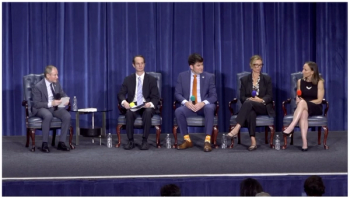
Medical Economics spoke with MGMA's Madison Hynes about the association's draft bill to ban automatic downcoding, the Patients First Act and AI-run prior authorization in traditional Medicare.
A new JD Power study shows satisfaction with Medicare Advantage falling for the second year in a row. For primary care physicians, the numbers explain a lot about what's landing on their desks.
Ask any primary care physician what's changed about treating Medicare Advantage patients over the past two years, and the answer rarely starts with clinical care. It starts with paperwork, phone calls, plan confusion and patients who no longer trust the coverage they signed up for.
That erosion of trust now has a number attached to it. According to the
“Healthcare has grown increasingly complex and exceedingly costly, and Medicare Advantage plans are juggling these challenging market dynamics while trying to guide their members to the best outcomes,” said Meaghan Hafner, senior director of healthcare solutions at JD Power. “While some stand-out performers are driving improvements in member satisfaction despite the challenges, the majority of plans are struggling to build a strong sense of patient advocacy and trust among their members.”
For physicians, that gap in advocacy and trust doesn't stay contained to the insurer's call center. It shows up in the exam room, in the billing office and in the front-desk conversations staff have every day about what a plan will and won't cover.
JD Power's study, now in its 12th year, surveyed 14,559 Medicare Advantage members across 12 states from January through June 2026, scoring plans on eight factors including trust, ease of doing business, and whether coverage helps members save time and money. The steepest two-year declines were concentrated in exactly the areas physicians hear about most: “Helping to save me time and money” fell 51 points, “Level of trust” fell 49 points, and “Product/coverage offerings meet my needs” dropped 47 points.
Those aren't abstract survey categories. They map almost directly onto the operational strain Medical Economics has been documenting all year — narrowing networks, unpredictable cost-sharing and plans that shift benefits or exit markets with little warning.
The study did find a bright spot: Plans that invest in onboarding and communication see outsized returns in trust. Among new members who say they understand their coverage very well, 34% feel their insurer helps prepare them for the unexpected and 29% feel their insurer anticipates their needs. Among members who don't understand their coverage, those numbers are nearly cut in half, to 17% and 16%, respectively. Special needs plans — built for members with complex chronic conditions or dual Medicare/Medicaid eligibility — also stood out, delivering meaningfully higher satisfaction and trust scores, which JD Power attributes to their higher-touch care coordination model.
In other words, the plans getting this right aren't necessarily spending less. They're explaining more.
The trust decline isn't happening in a vacuum. It's landing during a stretch when Medicare Advantage economics have tightened considerably after years of rapid growth. Cristin Hopkin Bishop, chief operating officer of The Brokerage Inc., a field marketing organization that supports independent insurance agents,
“The cost picture underneath, everything is getting tighter,” Bishop said. “There are well over 50% of the market of Medicare beneficiaries who are on a Medicare Advantage plan now, so it's becoming a dominant form of coverage. But you're seeing plans face pressure because of higher utilization with maybe outpatient care or inpatient services, or even the high cost of specialty drugs.”
That pressure is forcing insurers to reassess their networks and benefit design heading into 2027 bids, Bishop said, which in turn shapes which physicians patients can see and what supplemental benefits — dental, vision, hearing, over-the-counter allowances — remain intact. “What do their benefits look like? What's their doctor network? What doctors and physicians are they going to be working with?” she said.
She did not predict a wholesale retreat from the supplemental benefits that draw members to Medicare Advantage in the first place, since those benefits are what differentiate MA from traditional Medicare and Medigap. But she acknowledged plans are actively deciding where to reinvest and where to pull back — decisions members often only discover once they're already affected.
That uncertainty is precisely what shows up in JD Power's trust and “saving time and money” scores. When members don't know whether their plan will still cover their preferred pharmacy, specialist or supplemental benefit next year, trust erodes before a single claim is even denied.
The trust gap isn't only a member-experience problem — it's increasingly a practice revenue problem. Scott Woods, founder of Patient Coverage Connect,
The numbers behind that scenario are stark. Nearly a quarter of prescriptions written for Medicare beneficiaries go unfilled due to payer rejections or high copays, according to IQVIA data, and the average Medicare Advantage drug plan deductible has nearly quadrupled in a single year, per the USC Schaeffer Center. At least 25 health systems have cut ties with certain Medicare Advantage plans so far in 2026, and up to 1 in 10 enrollees now face forced disenrollment as insurers exit markets — disruptions that state insurance commissioners are now asking CMS to address with new Special Enrollment Periods.
Compounding the strain, physicians are also finding it harder to collect what patients owe at the point of care. Glenn N. Pomerance, M.D., told Medical Economics how evolving CMS-aligned interpretations of billing guidance are pushing practices to wait for claims adjudication before collecting copays, rather than collecting upfront as they once did. The delay is expensive: post-service statements cost more to generate and are far less likely to be paid, especially now that medical debt carries less weight in credit reporting. For independent practices already running on thin margins, the effect is a slow transfer of financial risk from insurers to providers — one more layer of friction stacked on top of the trust problems JD Power is measuring at the member level.
None of this is new territory for primary care — prior authorization delays, network churn and cost-sharing confusion have been building narratives in Medical Economics all year. What the JD Power study adds is a national, quantified confirmation that patients feel it too, and that their confidence in their coverage is deteriorating in step with the operational friction physicians already navigate daily.
The practical takeaway for practices may be less about the insurance mechanics and more about where physicians can still exert influence: patient education. JD Power's onboarding data suggests that members who understand their coverage trust their plan roughly twice as much as those who don't — and while insurers own the enrollment experience, physicians and their staff are often the ones patients turn to when a claim doesn't make sense or a benefit disappears. Practices that build in even light-touch coverage checks — flagging patients on mismatched formularies, watching for network exits before they cause missed visits — may be doing more than good customer service. They may be protecting revenue that would otherwise quietly erode into bad debt.
Medicare Advantage isn't shrinking. It now covers well over half of Medicare beneficiaries, and JD Power's rankings show plenty of insurers still earning strong marks in individual states — Kaiser Permanente in California, UPMC For Life in Pennsylvania, Blue Cross Blue Shield of Tennessee, among others. But the national trend line is clear: trust is falling, and the plans bucking that trend are the ones investing in communication and care coordination, not just benefit design. For physicians caught in the space between what patients expect and what their coverage delivers, that's a dynamic worth watching closely heading into 2027.
As Pomerance put it, the stakes go beyond any one billing dispute or satisfaction score: “Healthcare cannot function on delayed clarity and diminished accountability. Patients deserve to understand their obligations. Physicians deserve to be paid for their work.”