Coding scrutiny, payment gaps and a push for price caps show up across Trilliant Health's annual look at where U.S. health care is headed.
New report outlines economic and educational outcomes, along with practice trends from DO education.
Osteopathic medical education (OME) has grown to a $6.2 billion part of the U.S. health care system and overall economy, according to a first-of-its-kind study.
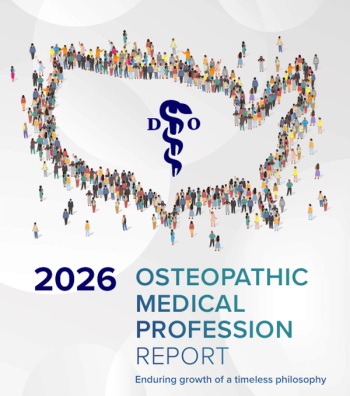
The American Association of Colleges of Osteopathic Medicine (AACOM) published the first Osteopathic Medical Education Impact Report analyzing the economic growth and physician work trends of OME.
The result: 44 accredited colleges of osteopathic medicine (COMs) support 38,155 jobs and $6.2 billion in total economic output. The total includes direct, indirect and induced employment, labor income, and gross domestic product.
“Across America, communities are facing the harsh realities of the national physician shortage and an overstretched health care system. This report demonstrates OME’s vital role in shaping a healthier future for all,” AACOM President and CEO Robert A. Cain, DO, FACOI, FAODME, said in a statement.
“Our schools are training physicians who serve where they’re needed most and fueling local economies along the way,” Cain said. “Together, we’re shaping competent, compassionate doctors who make a real difference every day.”
The 44 COMs have 71 teaching locations in 36 states, as of September 2025. Among them, 36 COMs this year conferred 8,428 osteopathic medical degrees (DOs); the full group had more than 39,000 medical students enrolled as of fall 2024.
The direct economic impact includes 20,770 jobs earning $1.3 billion in wages. Indirect and induced economic effect totaled 17,385 jobs paying $1.1 billion, with the indirect effect created through AACOM member institutions purchasing needed materials and services from suppliers. Induced economic effect is created through consumer expenditures.
For jobs, every 100 positions in AACOM institutions support 84 additional jobs in other industries, the report said. Finance and real estate led with 4,033 indirect and induced jobs, followed by health, social services and education (2,248), hotels, restaurants and entertainment (2,010), retail and wholesale (1,875), professional and technical services (1,710), and more.
As for COM spending, the colleges spent $943 million on instruction, $178 million on research, and $1.47 billion on other expenditures.
“By educating thousands of new physicians each year, COMs play a vital role in meeting the nation’s
growing demand for health care professionals, particularly in essential fields, such as primary and preventive care,” the report said. AACOM tallied physician specialties, and primary care dominated for DOs.
The report logged 127,287 AACOM alumni DO physicians, with 41,946 in family medicine, 19,363 in internal medicine, 7,794 in pediatrics and 1,963 in other primary care, such as geriatric care.
Another 31,176 DOs worked in peri-primary care, or specialties that support primary care, including 12,278 emergency physicians. Surgery, obstetrics and gynecology, and psychiatry all had more than 5,000 physicians, and there were 2,549 specialists in physical medicine and rehabilitation.
Among the alumni physicians, at least 14,300, 12%, were practicing in rural areas and 18,700, or 16%, were practicing in medically underserved areas, the report said.
“These numbers tell a powerful story,” Cain said. “Every new COM, every graduating class and every new physician represents healthier patients, stronger communities and real hope for the future of health care.”
AACOM commissioned the report by EY Quantitative Economics and Statistics, which used a variety of data sources, including the colleges’ own enrollment, graduate, alumni and employment figures, and models that incorporate industry-specific data on employee compensation, productivity and operating expenses.