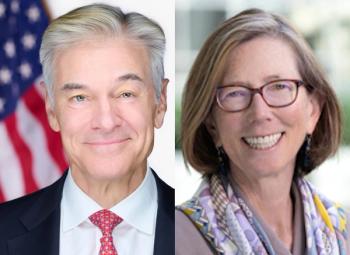
National Association of ACOs hosts leader at fall conference.
KFF's pre-election poll found voters trust Democrats over Republicans on health care costs by 20 points, and public support for a single government plan moves sharply depending on the argument people hear.
Sixty percent of registered voters said they are worried about affording health care for themselves and their families, tying gasoline and transportation costs (59%) at the top of their money worries weeks before the Nov. 3 midterm elections, according to the latest
The same poll found 66% of U.S. adults favor a national health plan, often called Medicare for All, in which all Americans would get their insurance from a single government plan. That is the highest share KFF has recorded since it began asking about the idea in 2016, up from 53% when it last asked, in October 2020.
KFF surveyed 1,328 adults, including 1,013 registered voters, online and by telephone in English and Spanish from Sept. 16-21. The margin of sampling error is plus or minus 3 percentage points for the full sample and plus or minus 4 points for voters.
Among all the cost-of-living pressures voters face, "a big health care bill is the least predictable," Drew Altman, Ph.D., KFF president and CEO, said in a
Eighty-two percent of voters said it is very or extremely important for candidates to discuss health care costs in the final weeks of the campaign, including 47% who called it extremely important. Only the cost of living ranked higher, with 62% calling it extremely important.
Fifty-nine percent of Democratic voters and 49% of independents said health care costs were extremely important for candidates to talk about, compared with 31% of Republican voters. Republican voters ranked fraud in government programs first, with 54% calling it extremely important, a result KFF researchers said suggests Republican leaders' messaging on fraud is reaching the party's base.
Asked in their own words what they want to hear from candidates on health care costs, voters most often said they want a plan to bring those costs down. Ashley Kirzinger, KFF's director of survey methodology, told
Forty-two percent of voters said they trust Democrats to do a better job handling the cost of health care, compared with 22% who chose Republicans. Another 28% trusted neither party and 8% trusted both equally. When KFF asked in
Democrats also led on the cost of living (39% to 25%), abortion policy (42% to 27%) and the conflict with Iran (36% to 27%). Voters were more closely divided on immigration, where 38% favored Republicans and 34% favored Democrats, and on fraud in government programs, at 31% for Republicans and 29% for Democrats.
Among independent voters, 38% trusted Democrats on health care costs and 9% trusted Republicans, while 43% trusted neither party.
Democratic voters were also more likely to say they are more motivated than usual to vote this year, 63% compared with 41% of independents and 38% of Republicans.
Thirty-six percent of adults said the U.S. health care system has so much wrong with it that it needs a complete overhaul, and another 49% said it has some good things but needs major changes. That view crosses party lines, with 89% of Democrats and 77% of Republicans calling for an overhaul or major changes. Republicans were about twice as likely as Democrats and independents to say only minor changes are needed, 21% compared with 10%.
Majorities of Democrats (84%) and independents (72%) favor a national health plan, while 66% of Republicans oppose one, including 48% who strongly oppose it. Seventy-five percent of adults ages 18 to 29 favor the idea, compared with 54% of those 65 and older, most of whom are already enrolled in Medicare.
Support shifted sharply when respondents heard claims from each side of the debate. It fell to 24% when people were told a national plan could lead to delays in getting some medical tests and treatments, to 35% when told most Americans would pay more in taxes and to 38% when told it would threaten the current Medicare program. It rose to 76% when people heard it would guarantee health insurance as a right for all Americans and to 75% when told it would eliminate premiums and reduce out-of-pocket costs for most Americans.
The prospect of eliminating private health insurance companies split the public, with 52% in favor and 47% opposed. When KFF asked the same question in October 2020, 37% favored the idea and 58% opposed it. KFF researchers wrote that majority support in the abstract is likely to shift over the course of any public debate in which people hear arguments for and against such a plan.
Democratic Senate candidates in Maine, Minnesota and Florida have campaigned on replacing the current insurance system with broad Medicare coverage,
Rogers has said millions of Michiganders with private insurance would lose that coverage under Medicare for All, and he has pointed to estimates that it would cost about $4 trillion a year. A preprint study from Yale researchers estimated the cost of implementation at $4.2 trillion and projected about $1 trillion in savings on health care spending, according to the KFF Health News report.
Jonathan Oberlander, Ph.D., a professor at the University of North Carolina at Chapel Hill who studies the politics of health care reform, told KFF Health News that even with an El-Sayed win, the chances of Medicare for All replacing the current system "remain very remote in the short to medium term."
In 2020, the American College of Physicians (ACP)
In 2019, the American Medical Association's House of Delegates