

A Cleveland, Ohio internist tells how he collects and ships supplies to care for the sick and wounded in war-torn Ukraine
A Cleveland, Ohio internist tells how he collects and ships supplies to care for the sick and wounded in war-torn Ukraine

What does adding new techn have to do with the parable of the elephant and the chain?


No-shows can wreak havoc on your schedule and financial performance. Here's how to nip them in the bud.

Whether you are pitching an investment opportunity or need to get a point across to a patient quickly, an effective elevator speech is a must.

Staff meetings can either drag your practice down or lift it up.

How to create a mission statement — and a sense of purpose — for your medical practice.
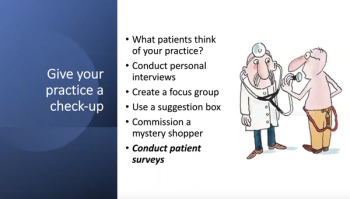
Are your patients satisfied with the service your practice provides? Here's how to find out.

Don't let patients get a bad impression over the phone of the service you provide at your practice.

What's the best way to manage personnel issues with a problem employee?

Sanjay Rajagopalan, MD, the Herman K. Hellerstein, MD, chair in cardiovascular research at University Hospitals of Cleveland Harrington Heart & Vascular Institute, discusses the link between cardiovascular disease and air pollution and how primary care doctors can help patients lower their risk of cardiovascular disease caused by air pollution.

Don't ruin your career by getting on the wrong side of the False Claims Act.

Here are seven practices every practice must adopt if they will be successful long term.

Getting things fixed means going beyond blaming people for what went wrong.

Health care organizations are reluctant to share patient data due to privacy concerns, and because they view data as a corporate asset.

Deven McGraw, co-founder of the health data platform Ciitizen, sits down with Medical Economics to explain the information blocking rule and why there are still issues for patients to access their health data.
The Information Blocking rule applies to many organizations.
Organizations covered by the Information Blocking Rule must comply with requests to share electronic health information.

Set up the right system for success.
There are a lot of little strategies that can add up to big savings.
Keeping a close eye on cashflow is the only way to guarantee you’re getting the most profit out of your practice.
Patients are more likely to pay if you give them more options.
Don’t let bad processes costs you money.

Access to HIEs makes it much easier to respond to patients’ requests for their health data.

Health organizations can better control non-physicians even if money isn’t an issue.
All types of providers are needed for a health care team, but should these teams be led by doctors?
How HIEs can lower costs and improve quality of care.
Using information from an HIE has many benefits.