What exactly is your RAF score telling you about patients and coding? Here’s why the lower-RAF score clinic might be the better coder.
Industry analyst outlines how Medicare made a noteworthy inclusion in its 2025 rule.
As time, technology and treatments advance in 2025, physicians need to know about advanced primary care management, one of the latest developments in remote monitoring.
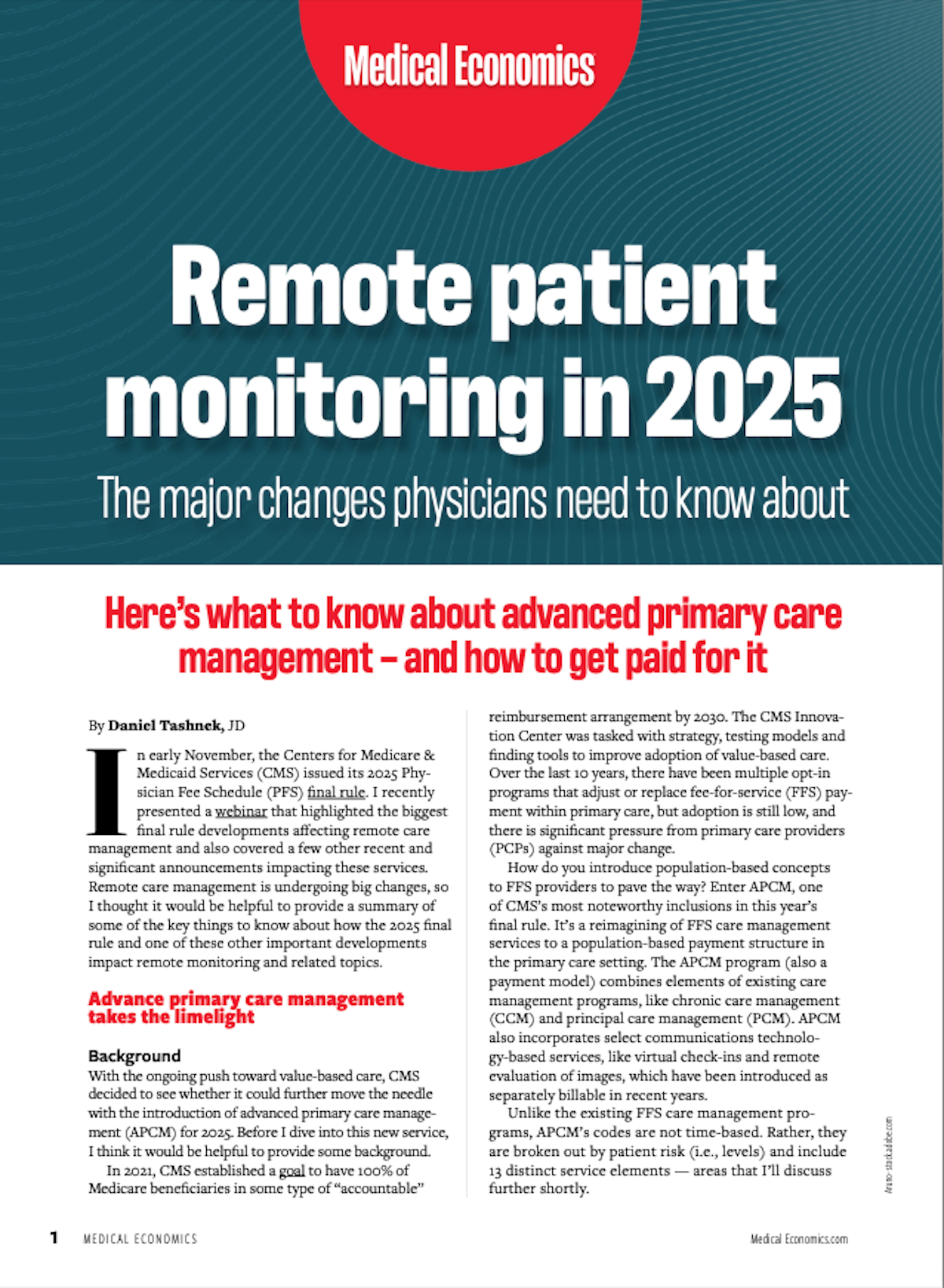
Daniel Tashnek, JD, is the author of “Remote patient monitoring in 2025: The major changes physicians need to know about.” Click on the cover of the guide at right to view it as a PDF file.
“Remote care management is undergoing big changes, so I thought it would be helpful to provide a summary of some of the key things to know about how the 2025 final rule and one of these other important developments impact remote monitoring and related topics,” he wrote.
At the top of the list: advanced primary care management (APCM). A noteworthy inclusion in the 2025 Medicare Physician Fee Schedule final rule, APCM reimagines fee-for-service management services to a population-based payment structure in the primary care setting.
Combined with remote patient monitoring and remote therapeutic monitoring, that can translate to significant revenue for physicians, with little downside risk in its current form, Tashnek wrote.
Tashnek is co-founder of
Here is a link to his earlier e-book,
Finally, be sure to check out Medical Economics’ additional coverage of