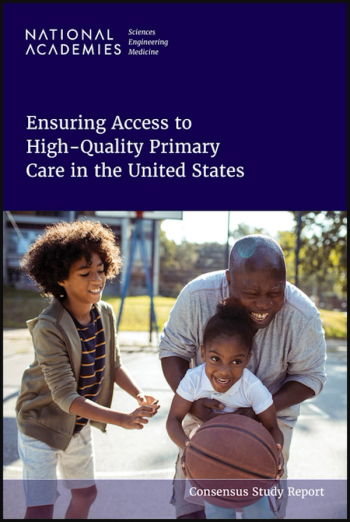
Five-year update to the 2021 National Academy of Medicine report finds little progress on access and calls for universal primary care coverage, more investment and a bigger workforce.
Is the time coming for primary care to move beyond traditional insurance? It’s worth a conversation, said a leader of the American Academy of Family Physicians.
Moving primary care outside of traditional insurance could be one way to improve funding and access that is lacking right now across U.S. health care, said the CEO of the American Academy of Family Physicians (AAFP).
The
The committee concluded primary care access has not improved in the five years since its 2021 landmark report,
In the discussion, Martin endorsed the concept, calling it the right thing, although not necessarily ready for prime time due to the complexity of health regulation and payment.
“I think big reforms come from big ideas that make people uncomfortable, and I think this is a big idea that makes a lot of people uncomfortable, and we need to keep doing work,” Martin said. He outlined a multi-point plan that would reroute “real dollars” to primary care, and took the ideas a step further.
“If we're really serious about primary care as a foundation for the health care system … we've got to get really comfortable with being uncomfortable about insurance,” Martin said. “I don't know that primary care needs to sit inside an insurance structure in the traditional way that we've talked about here today, and I think for us to be really innovative, we've got to get really comfortable with thinking about primary care not sitting inside what we would call a legacy insurance structure. And I don't know if the country is ready for that, but I think it's a conversation that needs to be had.”
Discussing a common fund for primary care, Gaumer started with payment. Would practices be paid under the physician fee schedule as it is now, or through something new, such as a bundled payment like those federally qualified health centers receive? He also asked who would pay for the fund.
“I think you need to figure out who’s going to pay for this,” Gaumer said.
Rae called the common fund “a really interesting idea” because it addresses fragmentation and gives patients consistency across their lives. But it would raise questions about how it interacts with private insurance, he said.
Martin later clarified that people still should have health insurance. Rae said coverage still matters. KFF estimates about 14 million people will lose health insurance by 2034 because of Medicaid changes and the expiration of enhanced premium tax credits. The NASEM report cites lower Congressional Budget Office estimates of 9.1 million to 10 million.
People who lose coverage are “about four times less likely to have a usual source of care,” Rae said. For people with insurance, he said more first-dollar coverage of primary care would expand access.
“I think the money has to flow to primary care, and I think we have just an enormous amount of financial intermediaries that are intercepting money in the healthcare system, and a lot of people, a lot of experts will say there’s plenty of money in the system. It’s just not getting to the right place, and I think I agree with that,” Martin said.
That money is not always salary, he added. “And I apologize to family physicians listening. You should make more money, but money really needs to flow to the function, and salary is just part of that.”
Martin also called for recentering the patient-physician relationship, noting that many people involved in health care “aren’t sitting in an eight-by-eight room when care is really delivered.” He said cost sharing becomes “both an economic but also a behavioral disincentive to primary care” and should be removed.
He reframed administrative burden as restoring physician autonomy. “All the checklists on quality measures, all the utilization management stuff, like, a lot of that stuff just needs to go away, and we need to let physicians and patients navigate a health care system through their shared goals,” Martin said.
One of the report’s recommendations is to at least double funding for the National Health Service Corps and shorten the timeline for Public Service Loan Forgiveness as ways to recruit medical students into primary care. That may not be enough on its own, Martin said.
“We need major tax reform, above the line tax credits that reward people to go into primary care, above the line tax credits that reward people to practice in rural communities. We’ve got to get at real dollars, not loan repayment and scholarships,” he said.
He pointed to the
Asked for one achievable policy, Martin proposed “something like a $75,000 above-the-line tax credit for five to 10 years for people that go into community-based primary care.”
“I think it would be ground-shaking, and I think you might see people go do it,” Martin said.